Manta Ray Snorkeling in Bora Bora: Where to See Mantas and How to Go
Manta ray snorkeling in Bora Bora: the Anau cleaning station, how deep the mantas are, when to go, how to behave around them and which kind of tour gives you a real chance. Sightings are never guaranteed.
Seeing a manta ray underwater feels slightly unreal. You are looking down at coral and blue water, and then a huge dark shape moves toward you with slow strokes of its wings. It does not flap or struggle. It glides.
Bora Bora is famous for its turquoise lagoon and for snorkeling with reef sharks and stingrays, but fewer visitors know that reef manta rays live here too. They gather at cleaning stations inside the lagoon, the best known near Anau on the east side, and you do not need to dive to see them: in clear water, snorkelers watch from the surface. The catch is that mantas are wild, and even at their favorite spots no sighting is guaranteed. Some trips go looking for them; many others stick to the coral gardens, stingrays and blacktip sharks. This guide covers where the mantas are, what an encounter is like, when to go, how to choose a responsible trip and what to do if they do not show.
If you want a booked day that names the manta area as a stop, the Full-Day Snorkel Tour with Lunch on Motu Fanfan spends about an hour in the Anau area, plus the Coral Garden and a shark and ray stop: 7 hours, $145 per person, rated 4.9 from 190+ reviews on Viator. You can check dates for it just below.
Check Availability
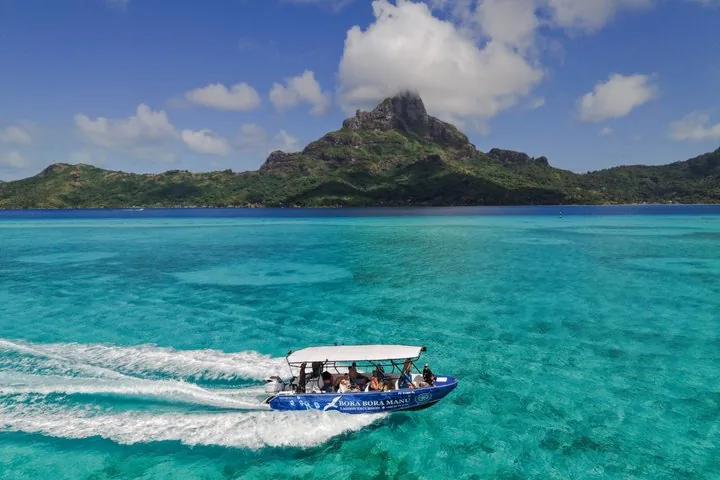
Full-Day Snorkel Tour with Lunch on Motu Fanfan
- 4.9/5 (190+ reviews)
- 7 hours
- Free cancellation
- Operated by BORA BORA MANU LAGOON EXCURSION
Includes Lunch on Motu Fanfan: grilled chicken and fish, raw fish in coconut milk, rice, taro and manioc · Banana po'e, coconut …
You'll choose your date and complete the booking on Viator. Free cancellation up to 24 hours before departure.
Can you swim with manta rays in Bora Bora?
Yes. Reef manta rays live in Bora Bora’s lagoon, and snorkeling trips sometimes see them at the Anau cleaning stations in the eastern lagoon. You watch the mantas move naturally through the water; you do not swim alongside them or chase them.
PADI’s Anau site page describes a coral garden, a reef slope and channels where the mantas come to be cleaned and to feed.
For snorkelers, three things have to line up:
- The mantas have to be there. A known manta habitat is not a guaranteed encounter.
- They have to be visible from the surface. On some days they stay deep enough that divers see far more than snorkelers.
- The conditions have to allow it. Visibility, wind, currents and access to the reef all affect the trip.
You can have an extraordinary encounter on a half-day tour. You can also visit a manta site and see none at all, and a good operator tells you so before you leave the dock. Our manta ray snorkeling tours page compares the bookable trips that name a manta stop; this guide covers everything around that choice.
Other Experiences
Other experiences you might enjoy
More Bora Bora snorkeling tours, each with its own page and booking link.
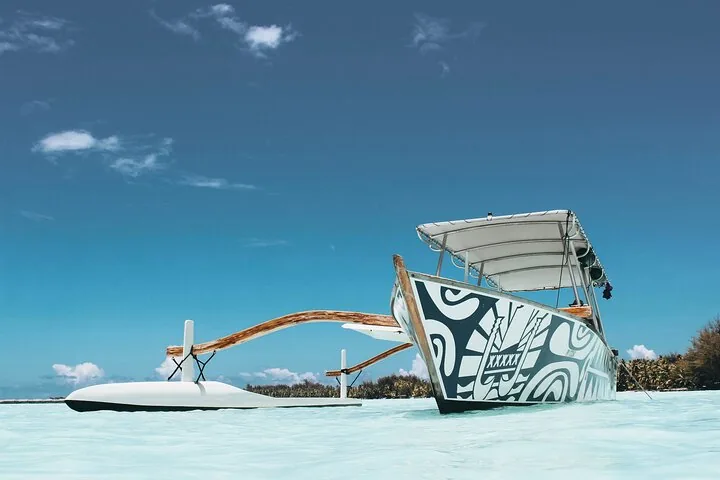
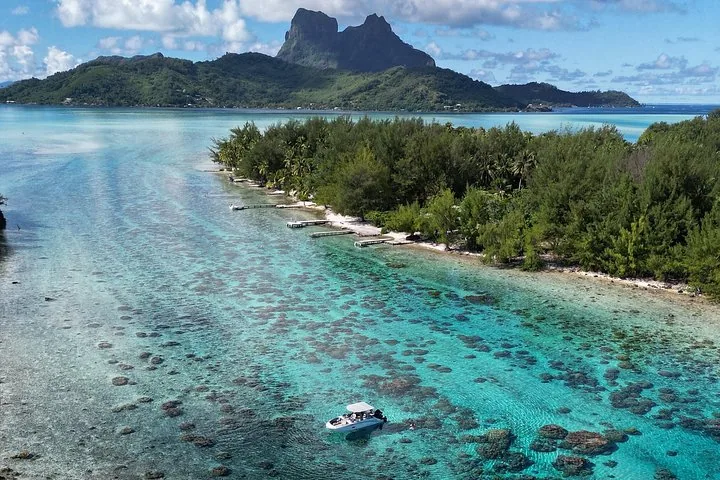
1. Anau: Bora Bora’s best-known manta ray snorkeling area
Best for: reef manta rays, watching a cleaning station and underwater photography.
Anau lies on the east side of Bora Bora, facing the wide stretch of lagoon between the main island and the outer reef. It is not a spot you would find from a beach walk: everything worth seeing is underwater.
The area has coral gardens, reef slopes and channels that reef manta rays use. Researchers and dive operators have recorded mantas visiting cleaning stations in this part of the lagoon for years.
What is the Anau manta ray cleaning station?
A cleaning station is a spot where mantas slow down or hover while small reef fish pick parasites and dead skin off their bodies. Think of it as an underwater grooming stop.
Instead of crossing the lagoon without pausing, a manta swims up to suitable coral, holds position near the cleaner fish and stays in the area while it is cleaned. That is what gives patient snorkelers the chance to watch one without following it.
How deep is Anau?
It varies across the site. PADI places the cleaning station in a coral garden about 6 m (20 ft) deep, with the reef slope dropping to roughly 17 to 20 m and channels of about 8 to 12 m where the current can get stronger.
Those figures describe different parts of a dive site, and snorkelers stay at the surface above them. You will be floating over water where you cannot stand, and a manta may be several meters below you. That is why Anau does not suit every beginner.
How do you get to Anau?
Take a guided boat trip with an operator who knows the area. Anau is also the name of a village on the main island, but the manta areas are offshore. Do not try to swim to a cleaning station from shore.
Can you see manta rays at Anau every day?
No. Mantas visit throughout the year, but how many turn up varies. Some days are excellent; others bring little or no manta activity. The weather also affects whether a boat can reach a given site safely.
Our recommendation: choose a tour run by guides who know Anau, with a good backup reef if the mantas are not there.
The Anau manta area sits inside the lagoon off the village of Anau, on the east side between the main island and the eastern motus. A map of the village shows you the general area, not the exact position of the cleaning station or a safe place to get in.
2. What are reef manta rays, and how big are they?
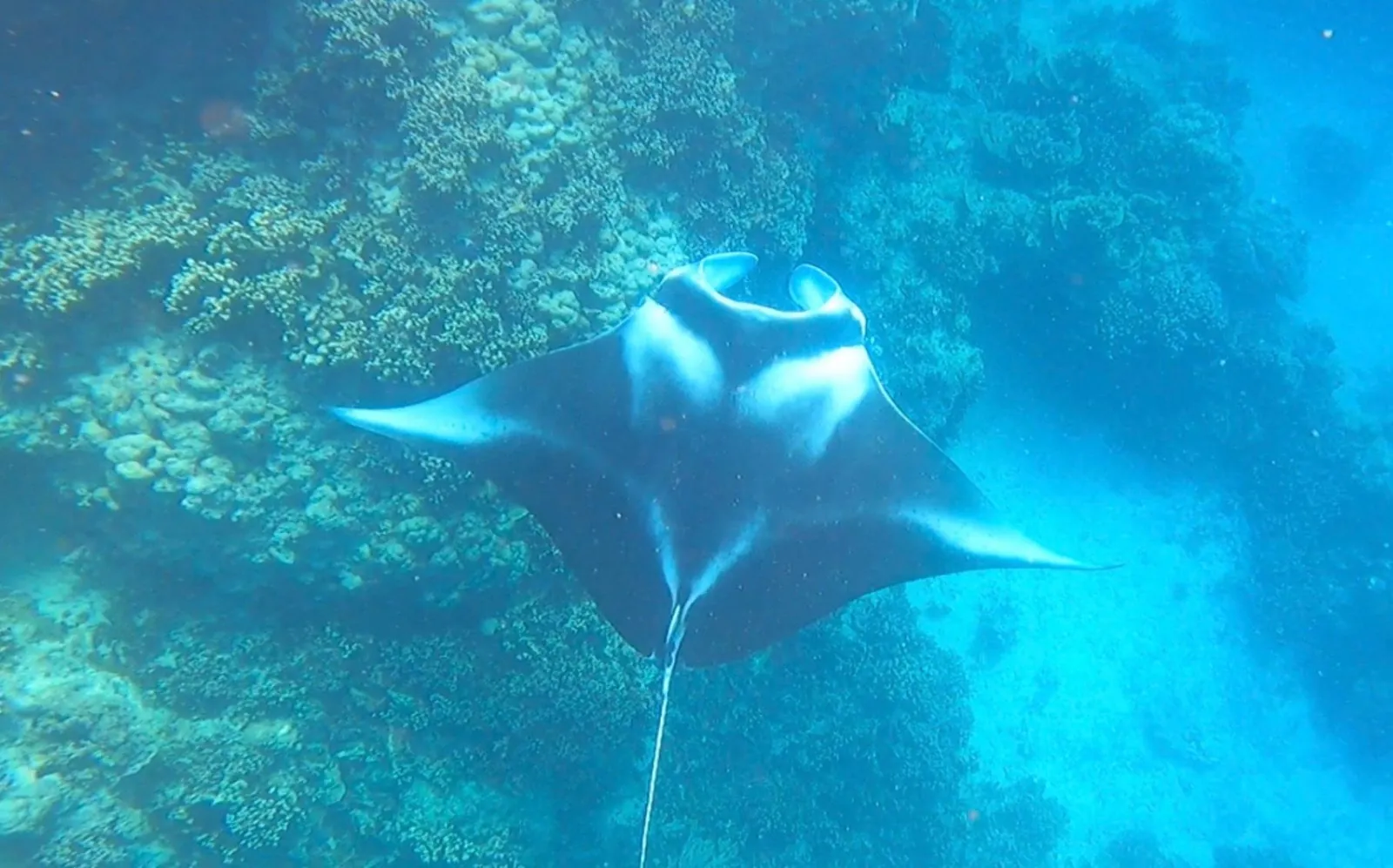
The mantas in Bora Bora are reef manta rays, Mobula alfredi. They are among the largest rays in the ocean, yet they feed on some of its smallest creatures.
Unlike the stingrays on the shallow sandbanks, reef mantas have huge triangular pectoral fins, a broad flat body and two fleshy lobes at the front of the head. These lobes, called cephalic fins, steer plankton-rich water into the mouth while the manta feeds.
How big are manta rays in Bora Bora?
Adult reef mantas are typically about 3 to 3.5 m (10 to 11.5 ft) across, roughly the length of a small car. For all that size, they move gently.
Do manta rays have stingers?
No. Mantas do not have the venomous tail spine many stingrays carry. They are filter feeders that never hunt fish or people, and they live mostly on plankton and other tiny organisms drifting in the water.
Are manta rays dangerous to humans?
Not to snorkelers who watch them responsibly. They have no sting and do not hunt people. They are still large, strong wild animals, and close contact can stress or injure them, so never touch a manta or try to hold on to one.
How are manta rays different from stingrays and eagle rays?
| Feature | Manta rays | Stingrays | Eagle rays |
|---|---|---|---|
| Typical body | Very broad, wing-like | Often rounded or diamond-shaped | Diamond-shaped with pointed fins |
| Diet | Filter-feed on plankton | Mostly animals on the sea floor | Shellfish and other bottom prey |
| Venomous tail spine | No | Many species have one | Some species have one |
| Typical Bora Bora encounter | At a cleaning or feeding area | Sandy lagoon shallows | Swimming over the lagoon or reef |
| How predictable on tours | Variable | Seen on most established routes | Variable |
The difference matters when you book. A trip sold as a ray snorkel may mean stingrays, not mantas. If mantas are your priority, look for the words “manta ray” in the itinerary itself and ask the operator where they look for them.
3. Best manta ray snorkeling tours in Bora Bora
Not every Bora Bora snorkeling trip goes looking for mantas. Many focus on blacktip reef sharks, stingrays and coral gardens, and a manta is a lucky bonus. Others stop where mantas are known to gather. If mantas come first for you, a guide who knows the cleaning stations matters more than a big sightseeing boat. These four Viator listings either name a manta stop or name mantas among the sights; our manta ray snorkeling tours page compares them with the rest side by side.
1. Reef Discovery Half-Day Snorkel Tour: 3.5 hours, $135 per person, rated 5.0 from 1,050+ reviews.
Best for: a shared half day with mantas high on the list, for beginners and families too.
The operator names manta rays, eagle rays and reef fish as the main sights, and recent guests describe a manta cleaning station, a large coral garden and a shark and ray shallow. The guides choose quieter spots on the day and get in the water with the group.
What to check: the listing publishes no fixed stop list, so ask whether your departure plans a manta stop. If you want a smaller boat, the Half-Day Eco Snorkeling Small-Group Tour takes eight guests at most for $133 per person (5.0 from 110+ reviews), and guests often describe a manta spot as the first stop, though the listing does not name one.
2. Tohora Bora Bora Private Lagoon Tour: about 3.5 hours, private boat, rated 4.9 from 32 reviews.
Best for: couples, families and photographers who want to set the plan.
Tohora launches from Anau itself, and the listing names manta rays, leopard rays, a coral garden and tropical fish among the stops, with the guide adjusting the route to the sea, the weather and the wildlife on the day. The price is per boat, not per person, and the snorkel gear is provided only on request.
What to check: 32 reviews is a small record next to the big shared boats, and the listing is non-refundable once booked, so be sure of your dates. Confirm that the manta stop can be the priority on your trip; a private boat buys flexibility, not a guaranteed sighting. Our private snorkeling tours page compares the other private boats.
3. Full-Day Snorkel Tour with Lunch on Motu Fanfan: 7 hours, $145 per person, rated 4.9 from 190+ reviews.
Best for: combining the Anau manta area with a full island day.
This is the one listing here whose itinerary names Anau as a stop: about an hour at the Coral Garden, about an hour in the Anau area, a long lunch on Motu Fanfan and an hour at a shark and ray stop. Guests often report a manta at Anau, but not on every trip.
What to check: the motu lunch is the longest block of the day, so ask how much of the seven hours is spent in the water. Fins and towels are not included.
4. Full-Day Snorkel Cruise with Sharks, Rays and BBQ Lunch: 6 hours, $155 per person, rated 4.8 from 740+ reviews.
Best for: a broad wildlife-and-culture day out.
An established lagoon cruise with several snorkel stops, gear, a BBQ lunch on a motu and pickup. Several recent guests report manta and eagle rays, but the main stop is the shark and stingray shallow.
What to check: if you prefer trips that watch the animals without feeding them, ask how the stingray stop is run before you book. Book it as a mixed lagoon day; mantas are a possible extra on it.
Routes, group sizes, inclusions and policies can change, so read the current listing for your date.
Which manta ray tour should you choose?
| Your priority | Our suggested tour type |
|---|---|
| Manta watching comes first | A shared or small-group half day whose guides check a manta station |
| A private experience | A private lagoon boat where you set the stops |
| Mantas plus a motu lunch | A full-day tour that names Anau |
| Sharks, stingrays and maybe mantas | A general multi-stop lagoon trip |
| Underwater photography | A small-group or private boat with an experienced wildlife guide |
| Traveling with non-swimmers | Confirm how they can watch before you book |
Five questions to ask before booking
These save you from booking the wrong trip:
- Do you regularly visit Anau or another known manta area?
- Is a manta stop part of the plan, or only a possible bonus?
- If there are no mantas, where else will we snorkel?
- How many people will be in the water, and how well do we need to swim?
- Do your guides follow a no-touching, no-chasing rule around mantas?
Do not expect a promise that you will see a manta. A good answer is a clear account of how the guide looks for them, handles an encounter and adapts to the conditions.
4. Best time of year to see manta rays in Bora Bora
You can see manta rays in Bora Bora all year. There is no fixed manta season of the kind the humpback whales have.
PADI describes Anau as a site where reef mantas can be seen through most of the year. The Manta Trust’s French Polynesia project says mantas visit the lagoon’s cleaning stations daily, and its research tracks repeat visits and movements between islands.
The odds are not the same every month, though. Mantas follow food, their cleaning needs and the conditions, and their movements are never fully predictable.
Month-by-month considerations
| Months | Typical weather | What it means for manta snorkeling |
|---|---|---|
| January–March | Hotter, wetter season | Mantas may be there, but rain can reduce visibility |
| April | Change toward drier weather | Can be good, depending on the day |
| May–June | Generally drier | Often good lagoon conditions, though wind matters |
| July–August | Drier, sometimes windy | Good potential; exposed sites can be choppy |
| September–October | Generally drier | Good snorkeling months, with conditions changing day to day |
| November | Change toward the wet season | Manta sightings still possible |
| December | Hotter, wetter | Trips run, with more changeable weather |
The table describes snorkeling conditions only, with no monthly sighting rates behind it. No published data shows that any one month gives the best odds of a manta. Our best time to visit Bora Bora guide covers the weather month by month.
Is morning better for manta rays?
Morning is often recommended for snorkeling, because the wind can be lighter and the boat ride smoother. Manta activity does not necessarily peak in the morning, though; cleaning and feeding vary with the site, the currents and the food in the water. If your operator keeps track of recent manta activity, follow their advice over any general rule.
How many days should you allow?
If mantas are a big priority, do not book your only trip for the last day of your stay. Booking early leaves room for a second trip if the weather cancels the first. That does not guarantee a manta, but it gives you a second chance.
5. What happens on a manta ray snorkeling excursion?
A manta trip usually starts with a boat ride across the lagoon. Depending on where you leave from, you cross pale shallows, pass the motus and go over darker reef. The guide explains the conditions and the plan for the day.
Step 1: Traveling to a suitable habitat
The guide heads for an area where mantas have been seen before, often Anau, and may change the route to follow recent sightings and the conditions.
Step 2: Checking for manta activity
A responsible guide checks the site before anyone gets in. If a manta is there, they show you where to float without getting in its way. If not, they may wait a little or move to another site.
Step 3: Entering the water
Slip in quietly and stay together as the guide asks. You may be floating over coral, deeper sand or a reef slope. Keep splashing and sudden movements to a minimum.
Step 4: Watching the encounter unfold
If a manta comes toward you, stay calm and let it choose its path. Sometimes it passes once and disappears. Other times it circles the cleaning area and stays in view for a while.
Step 5: Continuing to other lagoon habitats
Many trips also visit coral gardens, reef fish, sharks or stingrays. That matters most on a day with no mantas, because you still see a lot of the lagoon’s life. Our guide to the best snorkeling spots in Bora Bora covers those other stops.
6. Snorkeling vs scuba diving with manta rays in Bora Bora
Both can bring a manta encounter, but they are not the same.
| Feature | Snorkeling | Scuba diving |
|---|---|---|
| Qualifications | Usually none | Certification, or a supervised introductory dive |
| Where you watch from | The surface | Underwater, at permitted depths |
| Main advantage | No dive training needed | Better views when mantas stay deep |
| Equipment | Mask, snorkel, fins and flotation if needed | Full scuba gear |
| Typical experience | Looking down at passing mantas | Watching mantas at their own level |
| Main limitation | Depth and surface visibility | Training, health and dive limits |
Is scuba diving better for mantas at Anau?
Often, yes. When the mantas stay below the depth you can see clearly from the surface, a diver has the better view. Being underwater does not guarantee an encounter, though: a diver can visit a cleaning station and see nothing, while a snorkeler on another day watches a manta from the surface.
Can you freedive to get closer?
Experienced freedivers may be tempted to drop down when a manta is deep. Diving straight toward a manta or into an active cleaning station can disturb it, so follow the guide’s instructions and keep your distance. Never dive down just to chase a closer photo. For most visitors, staying at the surface is the right approach.
7. Responsible manta ray snorkeling: How to protect these animals
Manta tourism can support local communities and marine conservation, but badly run encounters disturb the very animals people come to see. The Manta Trust has recorded tourism disturbance and boat-strike injuries among Bora Bora’s mantas, which is why the operator you choose matters.
The essential rules
- Never touch a manta. Contact damages the protective mucus on its skin and stresses the animal.
- Do not chase or cut across its path. Stay still and let the manta decide how close it comes.
- Keep clear of cleaning stations. Do not float directly over an active cleaning spot or block the way in.
- Do not dive down toward a manta. Stay where your guide tells you to.
- Keep your distance. Stay at least 3 m (10 ft) away and let the manta come closer if it chooses.
- Do not crowd it. A ring of swimmers around a manta gets in its way.
- Skip the flash. Use natural light, and never trade distance for a photo.
- Never feed mantas. They are wild filter feeders, and their natural behavior should be left alone.
These rules follow the Manta Trust’s responsible interaction guidance for cleaning stations.
Why cleaning stations deserve special protection
Mantas return to cleaning stations because they need to be cleaned. When swimmers block the way in, crowd too close or keep following a manta, it may leave before it has finished, and the next group misses the chance to see natural behavior. The best encounter is one where the manta looks relaxed and carries on as normal.
8. Can beginners and non-swimmers see manta rays in Bora Bora?
It is possible, but the right trip depends on your swimming, the conditions and where the mantas are. Anau is not a shallow sandbank where everyone can stand. The best viewing spots may be over several meters of water, with currents that change.
For confident swimmers
A guided manta snorkel can be an excellent first manta encounter. You need to be comfortable floating in deep water, breathing through a snorkel and following instructions.
For first-time snorkelers
Practice in sheltered water before booking a manta-focused trip. A general coral garden trip is a gentler introduction to snorkeling than going straight to a deeper wildlife site.
For non-swimmers
Ask whether you can watch from the boat, though you will not always see much from the deck. Some operators provide flotation in suitable conditions, but that does not make a deep-water manta trip safe for someone who cannot swim.
What about children?
It varies by operator. Older children who swim confidently may enjoy a manta snorkel with close supervision. Younger children and nervous swimmers are better off on a sheltered lagoon trip. Always check the age limits and swimming requirements before booking.
9. How much do manta ray snorkeling tours cost in Bora Bora?
The price depends mainly on whether you join a group or book a private boat. The bands below are broad planning estimates, not live quotes; the tours above give current prices.
| Tour type | Rough budget | Typical length |
|---|---|---|
| Shared lagoon snorkeling | US$100–180 per adult | 2.5–4 hours |
| Small-group wildlife snorkeling | US$120–220 per adult | 3–4 hours |
| Full-day lagoon tour with lunch | US$150–300 per adult | 5–7 hours |
| Private snorkeling charter | US$500–1,200+ per boat | 3–4 hours or longer |
A private boat gets cheaper per person the more of you share it. It does not guarantee better manta sightings, though: the guide’s local knowledge and the mantas’ behavior matter more than the price.
What should be included?
Look for snorkel gear, a guide in the water, safety equipment, drinking water and clear pickup arrangements. Full-day trips may add lunch and other activities. Some operators ask you to bring your own fins or to request gear in advance.
What about cancellations?
Two situations are different:
- Bad weather: the operator may offer a new date or a refund, depending on the booking terms.
- No mantas seen: usually no refund, unless the operator explicitly offers a sighting guarantee.
Read the terms carefully before booking anything non-refundable.
10. What if you don’t see manta rays?
Even the best guide cannot call up a manta. Choose a trip you will still enjoy if the main attraction does not appear, with stops for the coral gardens, reef fish, stingrays or blacktip reef sharks.
Treat a manta as the main hope of the day, not the only good outcome. If your heart is set on one, ask the operator about recent sightings before booking, and leave time for a second try.
11. Manta ray snorkeling in Bora Bora vs Moorea
Both islands have manta rays, but the visitor experience differs. Bora Bora has the better-known manta cleaning stations, including Anau. Moorea’s best-known lagoon encounters are with stingrays and blacktip reef sharks, and mantas are not the focus of most trips there. Our Bora Bora vs Moorea snorkeling guide compares the islands beyond mantas.
| Factor | Bora Bora | Moorea |
|---|---|---|
| Reef manta habitat | Well-documented cleaning stations | Mantas occur, but most lagoon trips do not target them |
| Best-known encounters | Mantas, reef sharks, stingrays and coral | Stingrays, reef sharks and coral gardens |
| Best approach for mantas | A trip that names a manta stop | Ask specialist operators about recent sightings |
| Snorkeling on your own | Possible, but the key sites are offshore | Several easy shore and lagoon sites |
| Main thing to get right | Choosing the trip | Telling stingray trips from manta trips |
If seeing a manta is a central goal, Bora Bora is the better bet. If you mainly want colorful fish, sharks and rays, both islands deliver.
12. How manta ray conservation works in French Polynesia
Mantas are also important research subjects. Researchers identify them by photo: the spot pattern on each manta’s belly is unique, so the same animal can be recognized years later.
The French Polynesia Manta Project keeps a photo-ID database, studies how mantas move between islands and works with local guides on better tourism practice. It reports 137 different reef mantas identified in Bora Bora, a total that includes photos from a project run between 2000 and 2010. A more recent ISRA assessment counts 87 individuals photographed between 2015 and 2024 at a network of three main cleaning stations, with up to 15 mantas being cleaned at once.
Neither number means that many mantas are in the lagoon on a given day. Both count different animals recognized over the years.
Can tourists contribute to manta research?
Often, yes. A clear photo of a manta’s underside can let researchers identify the individual. Ask your guide whether your photos can go to a recognized manta research or citizen-science program, and never chase a manta or disturb it to get the shot.
Frequently asked questions
Can you swim with manta rays in Bora Bora?
Yes. Guided snorkeling trips sometimes see reef manta rays in the lagoon, especially around Anau. Sightings depend on the mantas, the conditions and the tour’s route.
Where is the best place to see manta rays in Bora Bora?
Anau, on the east side of the lagoon, is the best-known manta area. Its cleaning stations are visited by reef manta rays.
Are manta rays present in Bora Bora all year?
Yes, you can see mantas in any month. No site or trip can guarantee one on a given day.
Can you see manta rays without scuba diving?
Yes. Snorkelers watch mantas from the surface when the animals are at a visible depth and the water is clear. Divers get a closer view when the mantas stay deep at the cleaning stations.
How deep is the manta ray snorkeling area?
PADI places the Anau cleaning station in a coral garden about 6 m (20 ft) deep, with channels of about 8 to 12 m and a reef slope that drops to around 20 m. Snorkelers stay at the surface.
Are manta rays dangerous?
No. Mantas have no venomous tail spine and do not hunt people. They are still powerful wild animals, so watch them without touching or chasing.
What’s the difference between a manta ray and a stingray?
Mantas are very large filter feeders with wide, wing-shaped fins. Many stingrays live close to the sandy bottom, eat animals on the sea floor and carry a defensive spine on the tail.
Do all Bora Bora lagoon tours include manta rays?
No. Many tours mostly visit coral gardens and the stingray and shark stops. Choose a tour whose itinerary names a manta stop or a manta area.
What time of day is best for manta ray snorkeling?
There is no reliable best hour. Morning trips may get calmer water, but manta activity varies, so follow your guide’s advice based on recent sightings.
Can children snorkel with manta rays?
Some tours take children who swim confidently, depending on the site, the weather and the operator’s age and safety rules. Check directly before booking.
How close can you get to a manta ray?
Stay at least 3 m (10 ft) away, follow your guide’s rules and do not swim toward the manta. Let it choose its path, and never block a cleaning station.
Is it worth booking a manta ray tour if sightings aren’t guaranteed?
Yes, if you enjoy marine wildlife and the trip includes other good snorkeling stops. Pick a tour you would still enjoy if no mantas appear.
Final verdict: Is manta ray snorkeling in Bora Bora worth it?
Yes, as long as you treat it as a wildlife trip and not a guaranteed show. Few underwater moments match a reef manta moving through Bora Bora’s clear lagoon. Their size impresses, but you remember the calm, gliding movement.
Anau gives you a real chance to see them, and a guide who knows the cleaning stations makes a big difference. For most visitors, we recommend a shared or small-group snorkel that looks for mantas and also visits other good lagoon spots. If you want more control over the day, a private boat is worth it, especially for couples and photographers. Whichever you choose, give the mantas space and let the encounter happen on their terms, and book early in your stay so a weather cancellation still leaves time for another try.
More Bora Bora snorkeling guides
- Manta ray snorkeling tours: the bookable trips that name a manta stop, compared.
- Best snorkeling spots in Bora Bora: seven areas, from the Aquarium to Matira Beach, and how to reach each.
- Bora Bora coral gardens: the Aquarium, Toopua and Anau reefs in depth.
- Shark and stingray tours: the trips built around the shark and ray shallows.
- Best Bora Bora snorkeling tours: every type of snorkeling trip compared.
Get in the Water With the Rays
Free cancellation up to 24 hours before. Full-Day Snorkel Tour with Lunch on Motu Fanfan from $145 per person.
Check Availability & Book